
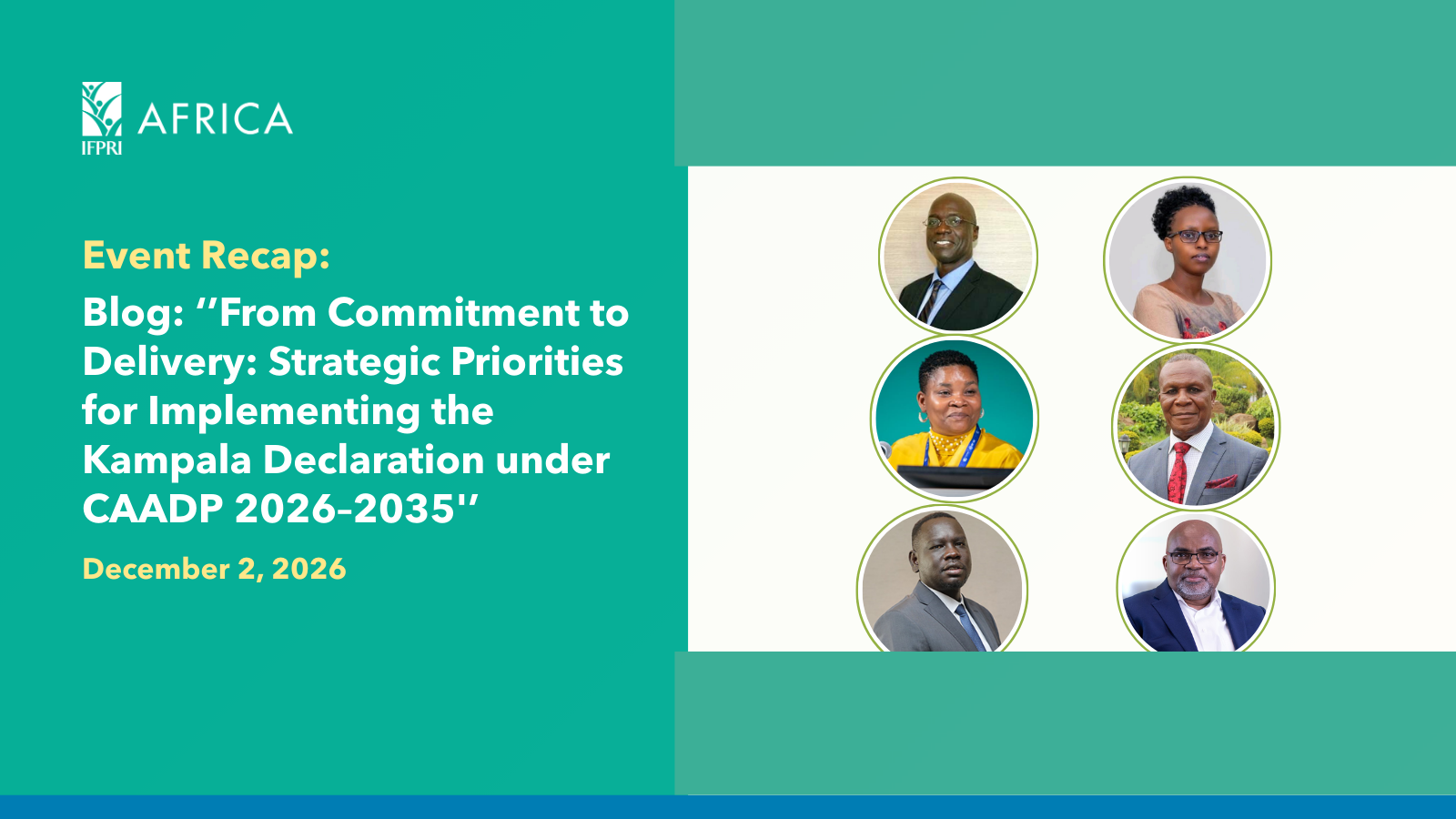
On November 26, 2025, The International Food Policy Research Institute (IFPRI) Africa office convened a high-level webinar to discuss strategic priorities for implementing the Kampala Declaration—the third cycle of the Comprehensive Africa Agriculture Development Programme (CAADP) for 2026–2035. The event gathered leaders from governments, regional institutions, research bodies, and farmer organizations, with a clear message: Africa does not lack policy ambition but struggles with implementation.
Dr. Steven Were Omamo, Director, Development Strategies and Governance (DSG); and Director for Africa at IFPRI opened by stressing that the “challenge is not vision but delivery”, urging stronger coordination, flexibility, and innovation to turn plans into outcomes. He emphasized that success will depend on delivery capacity, cross‑ministerial collaboration, and cutting bureaucratic frictions, setting the tone that the Kampala Declaration must move from vision to lived reality through systems that consistently deliver results. John Ulimwengu, Senior Research Fellow at IFPRI, highlighted the Kampala Declaration’s shift from agriculture to agri-food systems, with commitments to governance, agro-industrialization, and resilience. He also warned of persistent challenges—policy silos, weak coordination, and fragmented data—that must be overcome to make CAADP 3.0 a lived reality.
From Pathways to Practice: Farmers, Institutions, and Political Will for CAADP 3.0
As the conversation unfolded, four panelists brought complementary perspectives on what it will take to make the Kampala Declaration a lived reality. From Rwanda’s practical pathways to continental coordination by the African Union Commission, from the call for stronger political commitment and institutional capacity to the insistence on putting farmers at the center, their interventions converged on a common theme: CAADP 3.0 will only succeed if vision is matched by delivery. Together, these voices outlined the mix of intentionality, inclusivity, and accountability needed to transform Africa’s agri‑food systems over the next decade.
Mrs. Chantal Ingabire, Director General for Planning at Rwanda’s Ministry of Agriculture, shared Rwanda’s experience in integrating the Kampala Declaration into its Strategic Plan for Agriculture Transformation (PSTA 5). She stressed that “the very first and most important step is the mindset shift” toward a full agri-food systems perspective. Rwanda’s approach also emphasized early alignment with continental priorities, inclusivity through broad consultations, and stronger coordination via clusters on nutrition, climate-smart agriculture, and youth employment. She noted the creation of a Food Systems Coordination and Delivery Unit to track flagship programs and ensure data-driven decisions, concluding that integration is achievable if governments remain intentional, inclusive, and prepared for evaluation.
Mr. Kennedy Ayason Mukulia, Policy Officer at the African Union, explained that the Commission is positioning itself as the Secretariat to drive implementation of the Kampala Declaration by developing clear guidelines for member states. “We are tired of having policies. Now we need practice,” he stressed. These guidelines focus on governance, evidence-based diagnostics, investment design, and mutual accountability. The AU Commission is working with AUDA-NEPAD and regional economic communities to help countries integrate agri-food system priorities into national plans and budgets, ensuring commitments such as allocating 10% of public expenditure and reinvesting 15% of agri-food GDP are met. By strengthening capacity, promoting inclusivity of youth, women, and farmers, and reinforcing accountability through mechanisms like the Biennial Review, the Commission aims to ensure CAADP 3 delivers real transformation rather than remaining a declaration on paper.
Prof. Richard Mkandawire, Africa Director of the Alliance for African Partnership at Michigan State University, underscored that “political commitment is paramount” if the Kampala Declaration is to move from words to delivery. He called for champions to drive the agenda, dedicated funding mechanisms, and stronger institutions with the authority to convene across ministries. Warning that accountability has often been symbolic, he urged governments to strengthen peer review and commit tangible resources to ensure transformative food systems at the country level.
Mrs. Elizabeth Nsimadala, President of the Eastern Africa Farmers Federation and Board Member of PAFO, emphasized that farmer organizations must be central to CAADP 3.0. “We need to get intentional when we speak about bringing farmers to the center,” she said. The Eastern Africa Farmers Federation (EAFF) and PAFO are unpacking the Declaration for smallholders, building awareness, and strengthening advocacy tools like the FACT methodology. She highlighted initiatives such as the PAFO Kampala Meter to track farmer-led data and warned that most countries still fall short of the 10% budget commitment, investing only 3–4%. With Africa spending $70 billion annually on food imports, she called for an import substitution strategy, targeted investments, and stronger partnerships to empower farmers to produce locally and drive real impact.
One Game-Changer for CAADP 3.0
When asked what single action could most significantly boost the prospects for effective implementation of CAADP 3.0, panelists offered clear priorities. Mr. Kennedy Ayason Mukulia, Policy Officer at the African Union, emphasized that CAADP 3 must shift decisively “from policies to practice.” He highlighted the need for high-level political endorsement, multi-sectoral ministerial platforms, and stronger accountability to secure ownership at both government and member state levels. Mukulia stressed the role of lawmakers in ensuring adequate resource allocation and urged citizen engagement, noting that “if farmers can remind governments that they signed the declaration and must live up to it, then we gain stronger support.” Pointing to Africa’s $100 billion annual food import bill, equal to the mobilization target under CAADP 3, he warned that rapid population growth leaves no time to delay, insisting that collective responsibility is essential to deliver real transformation.
Prof. Richard Mkandawire emphasized urgency in building strong national alliances anchored in institutions with real gravitas, backed by evidence from global and national research bodies, noting that “all players must speak with one voice to push governments to act now.”
Mrs. Chantal Ingabire highlighted intentionality and flexibility, explaining that ministries must remain agile and collaborative to sustain progress. Finally, Mrs. Elizabeth Nsimadala underscored farmer representation, insisting that “farmers must be seen as equal partners, not beneficiaries of handouts,” and called for fairness, equity, and feedback mechanisms to ensure their voices shape decisions at every level.
Together, these insights point to the critical mix of political will, institutional strength, flexibility, and farmer inclusion needed to turn the Kampala Declaration into lived reality.
Conclusion: From Commitment to Delivery
Dr. Steven Were Omamo closed by reminding participants that the next CAADP decade will be judged not by the quality of the Kampala Declaration, but by the quality of its delivery. Success, he stressed, requires political commitment, coordination across sectors, strong institutions, and genuine inclusion of farmers and SMEs. “Without the voices of producers, rural communities, and SMEs, we risk designing systems that look good on paper but fail in practice,” he warned. Readiness, investing in systems, relationships, and evidence-informed pathways, emerged as the decisive frontier. With the Kampala Declaration providing a unifying vision, the true work now lies in preparing and supporting member states to implement effectively. If pursued with ambition, the coming decade can be the most impactful yet for Africa’s agri-food systems.
Sokhna Sall Seck is a Communications Specialist with IFPRI’s Development Strategies and Governance Unit.