
By Wim Marivoet and Audrey Lulu Mandi
Key takeaways:
• Senegal’s population is set to roughly double by 2050, but the food needed to feed everyone a healthy diet would have to almost triple.
• The biggest gaps are in dairy and eggs. Egg supplies alone would need to grow somewhere between 62-fold and 237-fold, depending on which healthy diet is used as the benchmark.
• Producing more is only half the problem. In 2022, half of the Senegalese people could not afford a healthy diet, so incomes and purchasing power have to rise alongside production.
This post summarises findings from a peer-reviewed article published in the journal Food Security.
Picture a shared meal in Senegal in the year 2050. More people have gathered around the communal dish than there are today, quite a few more. The country’s population is on course to grow from about 15 million at the time of the survey used in this study to roughly 34 million by mid-century. That alone is a daunting prospect for anyone thinking about how to keep a nation fed.
But here is the part that is easy to miss. Feeding twice as many people a healthy diet does not mean producing twice as much food. It means producing nearly three times as much. The gap between those two numbers, between “double” and “triple”, is the whole story of this research, and it is where the real challenge hides.
Why doubling the number of people means tripling the food
The reason is simple, and it has nothing to do with population arithmetic. It is about what is currently on the plate.
Senegal today, like much of the world, does not eat particularly well. Food supplies lean heavily on energy-dense staples: cereals, oil, and sugar. The things that make a diet genuinely nourishing, such as fruit, vegetables, legumes, and animal-source foods like milk and eggs, are in short supply. Fruit and pulse intake currently sit at around a quarter and an eighth of recommended levels, respectively. So when researchers ask “what would it take to feed everyone a healthy diet in 2050”, they are not just scaling up today’s food system. They are asking it to grow and to change shape at the same time.
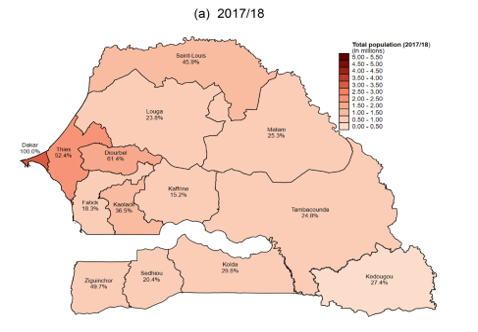
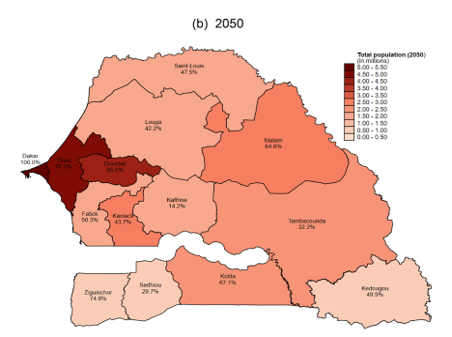
FIGURE 1: The two population maps of Senegal, 2017/18 and 2050, showing total population and urbanisation rates by region. Source: Figure 2 in the paper.
There is a geographic twist, too. Senegal is urbanising fast. The share of people living in towns and cities is expected to climb from just over half today to nearly two-thirds by 2050. That means a relatively small rural population will be responsible for producing a great deal more food for a relatively large urban population. Fewer farmers, more mouths, and a longer journey between the field and the fork.
Two recipes for a healthy diet
To determine what “healthy” actually requires, the study relies on two internationally recognised reference diets. They are worth meeting properly, because they do not entirely agree with each other, and that disagreement is instructive.
The first is the EAT-Lancet Reference Diet, designed to be healthy for people and for the planet. It is relatively light on animal products, partly for environmental reasons.
The second is the Hypothetical Micronutrient Adequate Diet, designed to address a more specific concern: ensuring adequate intake of micronutrients, such as calcium, iron, zinc, and vitamin B12. Because those nutrients are difficult to obtain from non-animal sources, this diet requires considerably more milk, eggs, and fish.
So the two diets pull in slightly different directions. One keeps the environmental footprint down; the other prioritises nutritional adequacy but costs more and relies more heavily on resources. Rather than crown a winner, the study runs both in parallel and lets the contrast speak. A useful instinct, because the honest answer to “which diet should Senegal aim for” is “it depends on what you are most worried about”.
Crucially, neither diet is imposed as a foreign template. The method takes these international targets and contextualises them, building each food group from items that people in a given region of Senegal actually eat and could plausibly produce. The goal is a healthy diet that still looks and tastes like Senegalese food, not a spreadsheet’s idea of nutrition.
The numbers that should make us sit up
Here is where the research delivers its jolt. To give every Senegalese person a healthy diet by 2050, total food supplies would need to grow by roughly a factor of 2.9 to 3.5, depending on the chosen diet. That is the tripling.
But the headline figure hides enormous variation between food groups. Some need only modest growth. Others need to grow at a rate that is frankly hard to picture.Cereals and sugar barely need to move. Senegal already produces enough of these, relative to what a healthy diet calls for, that supplies need to grow only modestly, slower even than the population. For unprocessed cereals, supply could actually fall.
Dairy is a different universe. Milk and milk products would need to increase roughly twentyfold.
And then there are eggs. Senegal currently produces a strikingly small quantity of eggs. To meet the healthy-diet targets, egg supplies would need to grow by about a factor of 62 under the first diet and about 237 under the second. Not 62%. Sixty-two times. It is the single most dramatic number in the study, and it captures something important: when a country eats very little of something nutritious, the climb to “enough” is almost vertical.
Fruit, vegetables, legumes, and meat all sit somewhere in between, needing to grow several times over. The pattern is consistent. The foods Senegal needs more of are precisely the foods it produces least of today.
Growing more is only half the job
It would be tempting to read all this as a production problem: build more farms, raise more chickens, milk more cows. And production certainly matters. The study notes that the required output could, in principle, be achieved through better yields alone, without clearing a single additional hectare, if Senegalese farms closed the gap with more productive countries.
But three complications make this harder than a simple “produce more” headline suggests.
First, logistics and perishability. Milk, eggs, fruit, and vegetables are exactly the foods that spoil fastest. Producing them is pointless if they rot before reaching a market. That means investing in storage, cold chains, processing, and transport, and placing it in the right locations, since production in Senegal tends to be concentrated in particular regions.
Second, the environment. Expanding livestock, dairy, and horticulture in a dry, Sahelian setting puts real pressure on soil, water, and biodiversity. The study points to practical responses, including healthier soil management, agroecological farming, cutting food losses, and digital tools for farmers, but it is candid that this is a genuine tension, not a solved problem.
Third, and most importantly, affordability.
A healthy diet you cannot afford is not a solution
Producing enough nutritious food means nothing if people cannot buy it. And here the picture is sobering. As of 2022, around half of Senegal’s population could not afford a healthy diet at all. The study finds that current food budgets across the country fall short of what these healthy diets would cost, with the shortfall consistently larger in rural areas than in urban ones.
Closing that gap is not a rounding error. For rural households to afford the more nutritious of the two diets by 2050, real food budgets would need to grow by around 3% every year for decades. That is achievable, but only under the most ambitious income-growth scenario in Senegal’s own national development plans.
This is the quiet, central message of the work. Feeding Senegal well in 2050 is not only an agricultural question or an engineering question. It is also a question of incomes, livelihoods, and fairness, of ensuring that the people who most need a healthy diet, and the rural producers, women, and young people who could supply it, are economically empowered to participate.
By 2050, the measure of success will not be who participates in every part of the food system, but whether people can earn dignified and fulfilling livelihoods and access nutritious food. Whether the plates in front of them are healthy ones is, this research suggests, still a choice, and a choice that has to be made now.
Wim Marivoet is a Research Fellow in the Development Strategies and Governance Unit of the International Food Policy Research Institute (IFPRI). His research interests include poverty measurement, spatial typologies, food systems, and food and nutrition security, with a focus on several African countries.
This post is based on peer-reviewed research.
Reference: Marivoet, W. 2026. Food supply implications of healthy diet consumption in Senegal by 2050. Food Security. https://doi.org/10.1007/s12571-026-01656-7