
By Fantu Bachewe, Geoffrey Baragu, Josue Niyonsingiza, Olufemi Popoola, Ismael Adeniji, Samson Dejene Aredo, Kalyani Raghunathan and Audrey Mandi.
Key takeaways:
- Millet losses in northwestern Nigeria are almost universal but modest in total. Practically every producer surveyed lost grain somewhere, yet losses across the whole chain average about 9% of volume and 6% of value.
- Losses at one stage are linked to losses at the next. Producers with higher preharvest losses were both more likely to suffer postharvest losses and to suffer worse ones.
- Where the chain frays differ by place. In Zamfara, the trouble starts in the field; in Sokoto, it starts after the harvest. The same intervention would not serve both.
There is a tidy way of thinking about food loss that almost everyone reaches for first. It goes like this. A pest outbreak is a field problem. Mould in a storage sack is a storage problem. Grain spilt off the back of a cart is a transport problem. Each stage keeps its own ledger, each ledger gets its own fix, and the sum of the fixes is the answer.
A study of millet in northwestern Nigeria suggests the ledgers are not separate at all. They are connected, and the connection runs downhill.
Researchers surveyed 595 millet producers, as well as 166 aggregators and 81 processors, across Sokoto and Zamfara states in 2024. Using an attribute-based approach that captures both physical grain loss and quality degradation (with associated price penalties), what they found, sitting inside the numbers, is a quiet, awkward pattern: the producers who lost the most before harvest went on to lose more after harvest. Not instead of. As well as. Damage appears to follow the grain.
Everyone loses something, and not very much
Start with the shape of the problem, because it is stranger than it first appears.
Losses in this value chain are close to universal. Nearly every producer surveyed reported losing millet at more than one stage. Preharvest losses were reported by roughly nine in ten. Postharvest losses were reported by essentially everyone. Every aggregator who dried grain reported losses while drying. Almost every processor reported losses, too.
And yet the total is not enormous. Across the whole chain, from field to processed product, losses average about 9% of the volume produced and about 6% of its value. That is a real number, and it aligns closely with independent estimates for millet in Nigeria, but it is not the catastrophe that the word “loss” tends to summon.
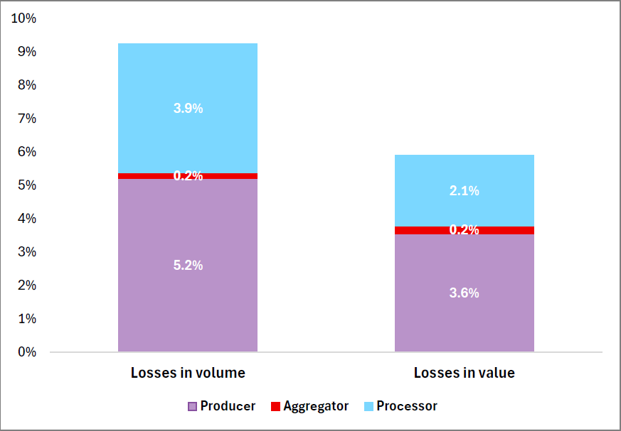
FIGURE 1: Estimated volume and value of food losses along the millet value chain. Source: Bachewe et al 2026
So the picture is one of breadth rather than depth. Losses are not concentrated in a few unlucky farms or a few bad actors. They are thin and everywhere, a small tax collected at every step, and the largest share of the bill falls on producers, who account for well over half of everything lost in volume and value. Aggregators, for their part, barely register. They buy, they bulk, they hold the grain just over a week, and they move it on before much can happen to it. Processors also incur noticeable losses during storage, handling, and transport, though these remain secondary to producer-level losses.
That distribution matters for what comes next. If the losses were concentrated downstream, the fix would be downstream. They are not.
The finding: losses do not stay put
Here is where the study earns its keep.
When the researchers modelled the likelihood and severity of postharvest losses, they included, among the usual suspects, a variable that most loss studies would never think to add: how much the producer had already lost before harvest. It turned out to matter. A larger share of preharvest losses was associated with a higher probability of postharvest losses and with more severe ones. The same held for a broader index of biotic and abiotic stress: the insects, diseases, weeds, and droughts that a farm endures during the growing season. Exposure to trouble in the field was linked to trouble in the store.
Why would that be? The most plausible reading is about what damage actually is. Some of it is quantitative and obvious: the grain that was eaten by birds is simply gone, and the accounting ends there. But a great deal of loss in this chain is qualitative, a matter of cracked husks, moisture, bruising, and fungal spores already present but not yet visible. That kind of damage does not announce itself at harvest. It waits.
And in this chain, it has time to wait. Producers store their millet for an average of roughly 93 days, mostly at home, on floors and in rhombus and barns , in a climate where higher rainfall and higher temperatures during the postharvest months were themselves associated with heavier losses. Three months is long enough for a small compromise in the field to become a large one in the sack.
The implication is uncomfortable for the way loss reduction is usually organised. Postharvest loss programmes tend to arrive after the harvest, with better bags and better bins, and they are worth having: the study finds that improved storage, winnowing, and improved transport were both associated with meaningfully lower postharvest losses. But if part of what those bins are being asked to contain is damage that was inflicted in June, then the bin is not the whole answer. It is the last line of defence for a battle that started earlier.
These are baseline data, and the research has not yet been peer-reviewed, and the authors are careful to note as much. The relationships they report are correlations drawn from a single survey round in two states, not effects proven by an experiment. But the direction of the association is consistent, statistically significant in both the likelihood and the severity models, and mechanically plausible. It is, at minimum, a hypothesis with teeth.
Same crop, opposite problems
If losses travel, then the interesting question becomes where the journey begins. And the study’s most practical finding is that the answer changes depending on where you stand.
Producers in Zamfara lost roughly twice as much as those in Sokoto, and their losses were front-loaded: preharvest damage dominated, driven by excess rain, poor seed quality, animals, and theft. In Sokoto, losses were smaller and arrived later, concentrated in the postharvest stage, with a very different set of complaints. Lack of rain was the overwhelming preharvest grievance there, cited by more than four in five producers, against fewer than one in three in Zamfara.
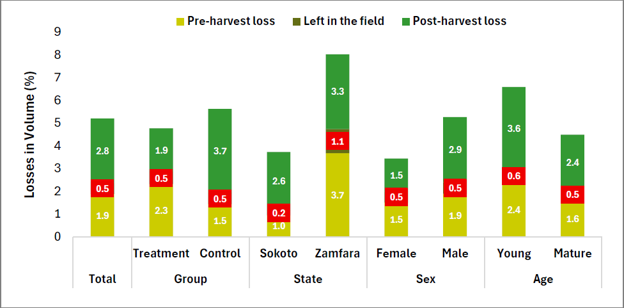
FIGURE 2: Food loss in the millet value chain as a percentage of the total volume (kg) of production. Source: Bachewe et al 2026
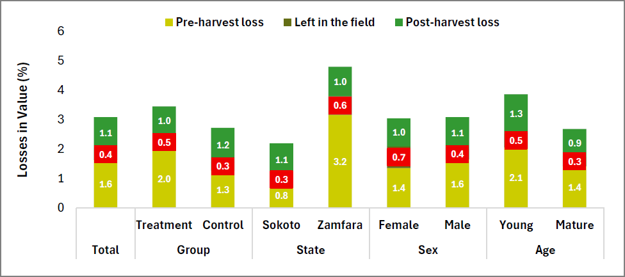
FIGURE 3: Food loss in the millet value chain as a percentage of the total value of production. Source: Bachewe et al 2026.
Two states, adjacent on the map, grow the same crop, and the loss profile inverts between them. Zamfara needs help before the harvest. Sokoto needs help after it. A national programme that ships the same intervention to both would be half right in each place, which is another way of saying half wrong.
The same logic applies across people, not just places. Youth producers lost more than mature producers at every stage, in both volume and value, a pattern the study links to the accumulated advantages that come with time: assets, land, and experience. Access to credit, greater asset ownership, larger millet plots, mechanical equipment, and training in harvesting were all associated with lower losses. Which is to say that the producers best placed to absorb a loss are the ones least likely to suffer one.
The chain reads both ways
There is something almost hopeful buried in a finding this gloomy.
If damage propagates, then so does its prevention. An intervention that reduces losses in the field is not only worth its own harvest. It is also, quietly, a postharvest intervention, arriving early and paying twice, if the correlation holds up under future, causally identified research. The pest control, the improved seed, the training in when and how to cut, all of these show up again three months later, in a sack that has less to fight against.
That is a different way of budgeting for food loss than the one the sector usually uses. It asks us to stop treating each node as its own small emergency and start treating the chain as a single object with a memory. The millet in a Sokoto store room in March carries the record of everything that happened to it since June. The question this research leaves open is how much of that record we are prepared to read.
This post is based on research that is not yet peer-reviewed. The opinions expressed are those of the authors.
Reference: Bachewe, F., Baragu, G., Niyonsingiza, J., Popoola, O., Adeniji, I., Aredo, S. D., and Raghunathan, K. 2026. Pre- and postharvest losses and their correlates in the millet value chain in Nigeria. SFS4Youth Working Paper #15. Washington, DC: International Food Policy Research Institute. https://hdl.handle.net/10568/182427