
IFPRI Blog: Research Post
By Fantu Bachewe, Harriet Mawia, Josue Niyonsingiza, and Audrey Lulu Mandi
Key takeaways:
- Young Rwandans are moving out of farming, yet two decades of data show off-farm food jobs have barely grown.
- The off-farm links in the value chain provide close to 10% of all employment.
- Older adults dominate employment in off-farm
This post is based on research that is not yet peer-reviewed.
There is a familiar way of describing how economies grow, and it runs a little like a staircase. Young people start on the bottom step, in farming. As the economy expands, they climb: off the farm but not out of food, into the enterprises that mill the grain, chill the milk, move the produce, and run the shop. Those steps are meant to pay better and sit closer to town. It is a tidy picture, and like most tidy pictures of development it flatters reality, which tends to move in fits and starts rather than a clean ascent. Still, the broad direction is supposed to hold.
Rwanda has a particularly strong case for this part of the story. About 75% of Rwandans are under 35, and the ratio of dependents to working-age adults has decreased significantly. This creates a classical demographic dividend: many potential earners, fewer dependents per person, and a limited-time opportunity that won’t last long. Additionally, this generation is the most educated Rwanda has seen. Youth literacy rates now surpass those of adults, with especially remarkable improvements among young women.
On paper, then, the staircase should be busy. The wider economy has grown more than fourfold over the two decades, incomes per person have more than doubled, and the share of workers in farming has fallen, in line with the standard model of structural transformation. And yet a new study tracking Rwandan employment from 2001 to 2022 finds that one step looks conspicuously thin. As young people move off the land, the step that was meant to catch them, the off-farm food economy of processing, trade, transport, and food service, has barely widened. The rung above farming is missing, or at least far narrower than the climb requires.
A food economy that is nearly all farm
Start with the shape of the thing. The agrifood system is the whole chain from the field to the plate, and in Rwanda it remains a source of employment for most of the population. But almost all that weight sits at the first node. Farming, the growing of crops and raising of livestock, dwarfs everything downstream of it: the processing, trading, transporting, and serving of food together account for only a small slice. Put plainly, the food system is large because farming is large, not because a broad off-farm economy has grown up around it.
That is unremarkable for a low-income, largely rural country. What matters is what happened as farming’s share of work fell. The off-farm part of the agrifood system, everything beyond the farm gate, accounted for a little under a tenth of total employment in the early 2000s and a little over a tenth by the early 2020s. Across two decades of rapid growth, it hardly moved. The internal picture is mixed rather than uniformly flat. Trade in food items such as grains, fresh produce, and processed goods nudged upwards, and transport of those goods roughly doubled off a very small base, signs that some absorption is happening, if modestly. But food processing, the milling, the dairy and beverage manufacture, and the packaging that turn raw produce into higher-value goods, moved the other way and declined. This is usually the part that signals a maturing food economy, because processing and services tend to pay more, cluster near towns, and pull productivity up behind them. In Rwanda, it is the part that shrank.
The generation the numbers are about
This is where the young population re-enters the story, and where the promise starts to strain against the record. Young Rwandans are considerably less likely than mature adults to be in the labour force at all, and that gap did not narrow over the period; it doubled. Youth unemployment runs consistently higher than adult unemployment, and it has been rising faster. Young people are far more likely than their elders to work informally, and that gap has widened too. At any given time, somewhere between a quarter and a third of young Rwandans are not in education, employment, or training.
Some of this has gentle explanations. Staying in school longer means being counted out of the labour force for a while, and Rwanda’s gains in schooling are real and worth celebrating. But longer schooling does not account for rising youth unemployment or deepening informality. Those point to something more stubborn: a labour market that is not yet making room for the very generation it most needs to employ.
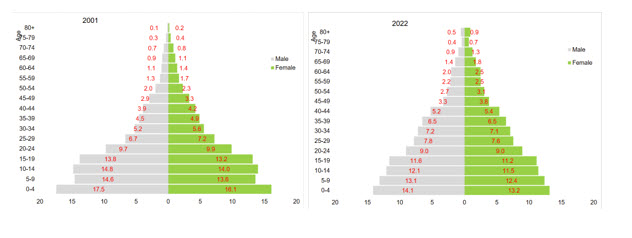
FIGURE 1: The age structure of Rwanda’s population in 2001 and 2022, showing the youth bulge. Source: Figure 3 in the paper.
The puzzle worth chasing
Here is the finding that should nag at anyone thinking about youth and food systems in Africa. When the researchers looked specifically at who works in the off-farm parts of the agrifood system, they found young people and older adults moving in opposite directions. The share of young workers in food processing, food service, agrifood trade, and transport fell over the period, while the share of mature adults in those same activities rose. The off-farm food jobs that do exist are, if anything, ageing.
This is not what theory would predict. Off-farm food work is supposed to be the part of the chain that best suits young people. It depends less on land, which young Rwandans increasingly struggle to obtain through fragmentation, inheritance, and cost. It sits closer to towns. It rewards exactly the literacy and schooling this generation has in abundance. A companion study on Senegal in the same working-paper series (Marivoet 2024) found young people being drawn towards these off-farm links rather than away from them, the opposite of the Rwandan pattern.
The study does not claim to know why Rwanda diverges. It is a descriptive picture assembled from national survey and labour statistics, not a design built to isolate causes, and the authors are careful to say that pinning down what pushes young people out of off-farm food work will take further research. But the divergence itself is instructive. It suggests that “expand the off-farm food economy and young people will follow” is an assumption rather than a rule, and that Rwanda may be meeting an obstacle a regional average would smooth over.
The gender pattern rhymes with the youth one. Women are more likely than men to work inside the food system and less likely to be found in its off-farm links. They concentrate in low-skill roles, and that concentration has grown rather than eased even as women’s education has surged. Women barely feature in agrifood transport. The one clearly encouraging note is that higher-skill jobs are now shared evenly between women and men, which the authors read as a foothold rather than a finish.
A staircase built from both ends
The instinct that follows is not to hurry young people off the farm. Farming will remain Rwanda’s single largest employer for the foreseeable future, and the authors argue for treating that as a foundation rather than an embarrassment. Raise agricultural productivity and rural incomes, and demand for processing, transport, trade, and food service grows on the back of it. The missing step, on this reading, gets built from both ends at once: a more productive farm sector below, and deliberate support for the off-farm food economy above.
But the harder question sits underneath. Rwanda has the young population, the falling dependency ratio, the schooling, and the growth. What it does not yet have is the rung of the ladder that turns all of that into work for the people who need it most. The demographic window is open now. If the step is still missing when it closes, what exactly will the past twenty years of growth have been for?
Fantu Bachewe is a Research Coordinator in the Development Strategies and Governance (DSG) Unit of the International Food Policy Research Institute (IFPRI). Harriet Mawia is a Research Officer in IFPRI’s DSG Unit. Josue Niyonsingiza is a Senior Research Analyst in IFPRI’s DSG Unit.
This post is based on research that is not yet peer-reviewed. The opinions expressed are those of the authors.
Reference: Bachewe, F., Mawia, H., and Niyonsingiza, J. 2024. The changing demographics in food systems and implications for future youth engagement in Rwanda. SFS4Youth Working Paper #3. Washington, DC: International Food Policy Research Institute.