



IFPRI Blog: Research Post
By Audrey Mandi, based on research by Hauwa Kabir, Emily Myers, Chibuzo Nwagboso, Salisu Alhassan, Olufemi Popoola, Jessica Heckert, and Kalyani Raghunathan
Key takeaways:
- In northern Nigeria, gender norms shape young women’s work within agrifood systems. Home-based processing is one of the few areas where young women face fewer restrictions than in open-field farming or public trading.
- Mechanised processing, however, is widely treated as men’s work, and young men have an easier time raising capital for equipment than young women, even though capital is scarce for almost every young person. Mechanised processing is one of the clearer routes to better income, and it currently runs through a door that is not socially acceptable for young women to walk through.
- Young women are also demanding processing equipment and storage support, a sign that they intend to keep pace with mechanisation rather than be pushed out by exclusionary gender norms.
This post is based on research that is not yet peer-reviewed.
A woman in Sokoto who processes soybeans was asked a simple question: could she teach a young man to do what she does? He would not want to learn from a woman, she said, because taking instruction from a woman would embarrass him. And in any case, before she could teach him, she would need her husband’s permission.
Two constraints, one sentence. That short exchange, drawn from a new qualitative study of young women and young men in northern Nigeria’s agrifood systems, is a useful starting point. Work here is not sorted by who is capable of doing it. Instead, it is allocated according to whether it is acceptable for them to do the work.
Underneath the findings that follow sits the same current: restrictive gender norms determine what kind of work is acceptable for young women and young men, and that determination is not fixed. Interventions should combine gender-responsive and transformative approaches to foster real change and strengthen development efforts.
Researchers conducted in-depth interviews and sex-segregated focus group discussions with young women and young men across Adamawa, Borno, Kano, Sokoto, and Yobe, as well as additional interviews with traders, financial service providers, programme staff, and community leaders. This qualitative study focused on understanding the opportunities and barriers for young women and young men in agrifood systems. Here we dive into one of those key barriers, restrictive gender norms, to understand why and how they limit opportunities.
The door that opens more easily
Farming, in much of the region, still carries the label of a man’s job, even though plenty of young women contribute labour to agricultural production. Gender norms don’t specifically restrict farming per se, but do limit more visible or mobile activities: young women more often work a plot near the dwelling, or grow crops kept low enough to stay in view of the household, while tasks involving machinery or cattle, and work that takes them far from home, remain largely closed to them. The reasons are often about visibility, about what happens to a young woman’s reputation when she spends unmonitored hours away from home, potentially in the company of men who are not her relatives, and, in communities affected by conflict, about a more concrete fear: that a young woman working far from home is more exposed to violence from rival groups or insurgents. Explaining these social norms can help policymakers develop targeted interventions that address safety and reputation concerns.
Marketing runs into a similar wall, though a more public one. Young women who sell in the town market are serious economic actors, but they are often subject to other people’s concerns about their reputation, safety, and propriety. As one focus group participant in Adamawa explained, many people see women trading in the market as contrary to norms, particularly when they are out late in the evening. Those enforcing the boundary are rarely distant authorities. More often, they are husbands and parents.
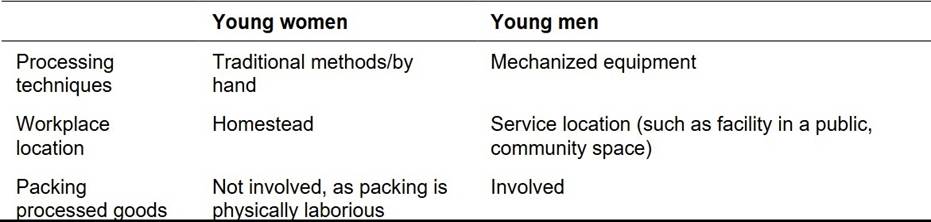
FIGURE 1: Comparison of youth processing in northern Nigeria by gender, showing the three rows most relevant to this post. Source: Table 6 in the paper.
Then there is processing, and here the door opens more easily. Grinding, winnowing, extracting oil, turning soybeans into awara: this is work done in and around the home, learned from mothers and aunts, and widely accepted as appropriate for young women. It is the node where young women participate most freely, even if it is not always the most lucrative; hand processing tends to pay less than trading or large-scale farming. Some young women describe it as work they can do from home, on their own terms, without needing anyone’s permission to leave. So, at first glance, the picture looks almost tidy: a narrow gate, but a real livelihood behind it.
The machines arrive
Mechanised processing is where the picture gets less tidy, and more revealing. Operating the equipment itself is widely seen as a man’s domain, much as it is in the field, and young men tend to find it somewhat easier to assemble the capital to acquire a machine, through inheritance, apprenticeships, and formal credit. But this is a matter of degree, not a clean divide: capital is scarce for almost every young person here, and some young men in the study felt young women had the edge, thanks to savings groups and programming aimed squarely at women. What comes through more clearly is this: home-based methods have a lower barrier to entry, machine-based ones a higher one, and that higher barrier currently tilts toward men.
Put those two facts together, and a consequence follows. The technology that makes processing faster and more profitable is the same technology that gender norms currently reserve for men to operate, and that credit markets currently make easier for men to acquire. Mechanisation does not have to overcome women’s roles by force. It can simply arrive, do its work, and shift who holds it, quietly and without anyone visibly crossing a line. To promote gender equality, stakeholders should consider specific interventions such as gender-sensitive credit schemes, targeted training, and community dialogues that challenge norms and promote women’s participation in mechanisation. However, the study also finds hints of quieter resistance: women negotiating to keep a hand in the process even once equipment is involved.
One interesting thing about this study is that it reframes a familiar developmental instinct: the instinct to add technology without thinking through the full consequences, or considering how young women experience it compared to young men. Bringing equipment into women’s activities sounds like a good idea. But “women” is not one group with one set of assets: young women typically have weaker claims to land, capital, and equipment than older women in the same households, and an intervention that ignores that risks handing the keys to whoever already has the strongest claim to them, which is rarely a young woman.
The norms bind young men, too.
Young men are also stuck. Several value chain actors described young men who want to move into processing and do not, because it is women’s work, and the shame of learning it from a woman is too much to carry. The norm that keeps young women out of the market keeps young men out of the kitchen. It is not a wall with one side.
That symmetry is not a consolation prize. It is a design opportunity. Young women in a Kano focus group offered one themselves: instead of buying raw goods from the market, why not link directly with the young men who grow them, process what they farm, and sell it together? The young men gain a reliable route to market. The young women gain a reliable supply. Nobody has to violate anything.
It is an elegant idea, and it comes with an obvious hazard, which the authors flag: an arrangement that works with the norms can just as easily bake them in, leaving young women as suppliers of labour in someone else’s business. Working around a rule and being trapped by it can look identical from the outside.
That is why the report pairs two kinds of suggestions. Gender-responsive approaches, such as systematised cottage industries built around shared equipment, operate within existing norms to help young women earn more today. Gender-transformative measures, such as household dialogues[1] with husbands and parents who enforce the norms, engagement with religious leaders and market managers, formalised mentorship, and financial products tailored to young people’s actual lives, aim to shift the norms themselves. The first set of tools helps young women earn. The second changes who is allowed to earn, and, just as importantly, who gets to keep control over what they earn: the equipment, the income, and the decisions about how both are used.
What dignity turns out to mean
When youth in this study described dignified and fulfilling work, they talked about profit, yes. But they also talked about being respected in the community, about pricing honestly and treating customers well, about the satisfaction of a customer who loves the dress you sewed and sends a friend. Dignity, in their telling, is partly conferred by other people.
And that is the knot. Some youth explicitly linked social recognition to doing work appropriate to one’s gender. If a community grants dignity for conformity, then the work that pays best and the work that is respected may not be the same. A young woman who buys a grinder might earn more, even as she risks being admired less.
The young women in this study seem to have decided the trade-off is worth making. Asked what they need most, they said processing equipment and storage facilities. That is not a small thing to say in a place where men currently own the machines that matter most.
Nor should that trade be one young women are left to make alone. Norms bend when husbands, parents, religious leaders, and market managers are willing to bend them too, so gender transformative programming has to build that willingness in men and communities, not just ask it of women. The deeper ambition is not simply more machines in more women’s hands. It is loosening the link between a person’s gender and the respect a job earns them, so that working hard, whatever the job, is what earns someone their standing.
The harder question is whether the programmes built around them are ready to hear it.
Hauwa Kabir and Salisu Alhassan are consultants based in Abuja, Nigeria. Emily Myers is a Senior Research Analyst, and Jessica Heckert is a Senior Research Fellow in the Poverty, Gender, and Inclusion (PGI) Unit of IFPRI, based in Washington, DC. Chibuzo Nwagboso and Olufemi Popoola are Research Analysts in IFPRI’s Development Strategies and Governance (DSG) Unit, based in Abuja. Kalyani Raghunathan was a Research Fellow in PGI at IFPRI while this research was conducted; she is now a Senior Economist at the Asian Development Bank, based in Manila.
This post is based on research that is not yet peer-reviewed. The opinions expressed are those of the authors. This work was produced as part of the Strengthening Food Systems to Promote Increased Value Chain Employment Opportunities for Youth partnership with the Mastercard Foundation.
Reference: Kabir, H., Myers, E., Nwagboso, C., Alhassan, S., Popoola, O., Heckert, J., and Raghunathan, K. 2026. Barriers and Opportunities for Youth in Northern Nigeria’s Agrifood Value Chains: Findings from Qualitative Research. SFS4Youth Working Paper #14. Washington, DC: International Food Policy Research Institute.
[1] A household dialogue is a structured, facilitated conversation among family members, often guided by a trained facilitator, about how work, income, and decision-making are divided at home. It is a well-established methodology in gender-transformative programming, not a tool unique to this study.