
Fresh insights from new research shaping Africa’s food systems, resilience, and economic development

Key Insight of the Week
Road infrastructure can be a powerful driver of agricultural productivity. Evidence from Malawi shows that access to paved roads is associated with productivity increases ranging from 35% to 57% over a 10-year period, highlighting the importance of rural connectivity for sustained agricultural growth and transformation.
Featured Report of the Week
Paving the way: The impact of road infrastructure on agricultural productivity in isolated African settings by Henry Kankwamba and Karl Pauw
Road infrastructure is widely recognized as an important enabler of agricultural growth, but evidence on its longer-term contribution to productivity remains limited in isolated settings. In this week’s Evidence for Africa, IFPRI researchers examine the relationship between paved road access and crop productivity in Malawi using three large, nationally representative survey datasets and group-time difference-in-difference estimation strategies.
The study finds significant positive effects of access to paved roads on crop productivity, measured by the average value product of land. Importantly, the estimated productivity gains increase over time, ranging from 35% to 57% over a 10-year period.
The findings highlight the broader role of rural road infrastructure in agricultural transformation. Improved road networks can strengthen farmers’ access to markets, reduce transport costs and postharvest losses, and create incentives for the adoption of productivity-enhancing technologies. The evidence provides a strong rationale for greater investment in rural roads as part of strategies to promote sustained agricultural productivity growth.
Other Recent Publications
Beyond infrastructure: Linking multiple-use water services and experiences with household water insecurity in rural Mali (OA; PR; ISI)
Stellbauer, Matt; Jepson, Wendy; Osborne-Gowey, Jeremiah; Lefore, Nicole; Connors, John Casellas; Kato, Edward
PLOS Water, 5(8)
Cost-effectiveness analysis of iron, vitamin A, and zinc biofortification in selected low- and middle-income countries: A modelling study (A Rank; OA; PR; ISI)
Zeng, Wu; Nam, Janice; Gao, Tianjiao; Lenaerts, Bert; Boy, Erick
Journal of Nutrition. First published online on July 27, 2026
Food systems performance evaluated against targets and benchmarks reveals urgent gaps and a path to 2050 (A* Rank; OA; PR; ISI)
Carducci, Bianca; Schneider Lecy, Kate; Nordhagen, Stella; Beal, Ty; Béné, Christophe; Gonzalez Fischer, Carlos; Herforth, Anna; Tubiello, Francesco N.; Ambikapathi, Ramya; Arunkumar, Krishna; Campeau, Christine; Dasgupta, Shouro; DeClerck, Fabrice; del Pino Álvarez, Inmaculada; Guarín, Alejandro; McLaren, Rebecca; Vivero-Pol, Jose Luis; Aburto, Nancy; Barquera, Simón; Battersby, Jane; Cafiero, Carlo; Conforti, Piero; Caron, Patrick; Cattaneo, Andrea; Covic, Namukolo; Elouafi, Ismahane; Fabi, Carola; Gephart, Jessica A.; Fremier, Alexander; Foley, Pat; Golden, Christopher D.; Hendriks, Sheryl L.; Huang, Jikun; Kennedy, Gina; Laar, Amos; Lal, Rattan; Lidder, Preetmoninder; Loken, Brent; Malapit, Hazel J.; Marshall, Quinn; Masuda, Yuta J.; Remans, Roseline; Resnick, Danielle; Saisana, Michaela; Sumaila, U. Rashid; Torero Cullen, Maximo; Webb, Patrick; Wiebe, Keith D.; et al.
Nature Food. First published online on August 10, 2026
From farmer-centred design to algorithmic participation: Navigating technical demands and normative discourses in digital extension (OA; PR; ISI)
Jones-Garcia, Eliot; Legun, Katharine A.; Klerkx, Laurens
Agriculture and Human Values, 43(3)
Responsible use of artificial intelligence and machine learning for food security early warning systems (A* Rank; PR; ISI)
Anderson, Weston; Becker-Reshef, Inbal; Bodanac, Nicholas; Carneiro, Bia; English, Dave; Hoell, Andrew; Hoffine, Tim; Liu, Yanyan; Machefer, Mélissande; Meroni, Michele; Raleigh, Clionadh; Tatem, Andrew J.; Trigwell, Robert; Vesco, Paola; Vos, Rob
Nature Food. First published online on August 6, 2026
Breaking the silence: Challenges in deploying language technologies for low-resource agricultural contexts (OA)
Mganga, Nelson; Jones-Garcia, Eliot
Count on me: Shocks and formal versus informal assistance in Somalia (OA)
Karachiwalla, Naureen; Leight, Jessica; Zafar, Sarim
IFPRI Project Note
IFPRI Malawi maize market report, July 2026 (OA)
International Food Policy Research Institute; Duchoslav, Jan; Benson, Anderson
MaSSP Monthly Maize Market Report
Intersecting gender and youth financial inclusion in agrifood systems: Evidence from northern Nigeria (OA)
Nwagboso, Chibuzo; Heckert, Jessica; Raghunathan, Kalyani; Myers, Emily; Popoola, Olufemi; Kabir, Hauwa
SFS4Youth Working Paper
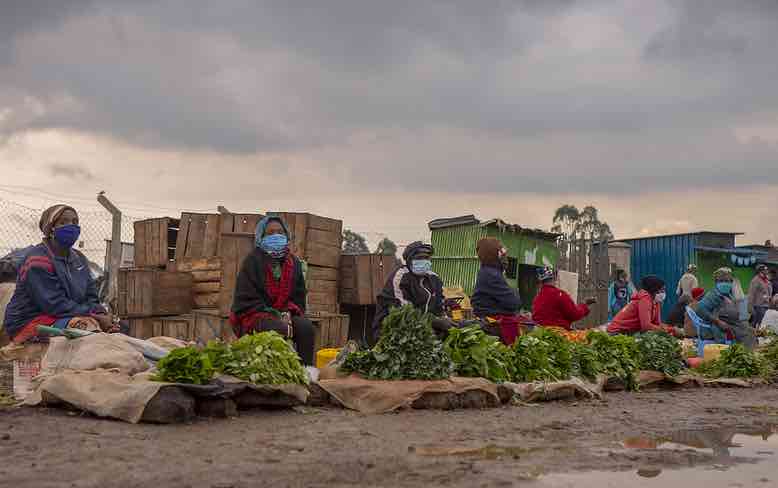
Lived experiences of weather-driven challenges in outdoor food markets in Kenya(OA; ISI)
Boncyk, Morgan; Gunaratna, Nilupa S.; Kamau, Joyce W.; Ambikapathi, Ramya; Kimenju, Simon; Frongillo, Edward A.; Berhanu, Anene Tesfa; Ghosh, Susmita; Matangi, Evidence S.; Avula, Rasmi; et al.
What is the current evidence on the effectiveness of climate finance interventions in improving climate resilience and socioeconomic outcomes among smallholder farmers in low- and middle-income countries (LMICs)?(OA)
Singh, Vartika; Ringler, Claudia; Eales, Jaqualyn; Mukherji, Aditi
About Evidence for Africa
Evidence for Africa highlights every week recent IFPRI research and insights relevant to the continent’s food systems, economic development, and policy priorities.
Looking for earlier versions?
Visit the archive of Evidence for Africa to explore past releases and insights here