
Research Post
By Sedi Anne Boukaka, Baragu Geoffrey, Carlo Azzarri, and Audrey Lulu Mandi
Key takeaways:
- In two of Kenya’s main potato-growing counties, roughly seven in ten farming households own a smartphone, yet only less than 5 percent use any agriculture-specific app. The device is in hand; the farming tool is not.
- Binding constraints are hardly hardware or even cost, but awareness and digital literacy. Most farmers who do not rely on agricultural apps simply do not know they exist nor feel capable of using them.
- Digital literacy lies one step away from the farm. The Farmer Service Centres use a far richer mix of apps to support and advise farmers, which is exactly where a new study trial hopes to build a bridge.
This post is based on research that has yet to be peer-reviewed.
Picture a potato farmer in the highlands of Nyandarua, up where the cool air and twice-yearly rains make the country’s favourite tuber grow well. She has a smartphone in her pocket. Most of her neighbours do too. On a continent usually described as sitting on the wrong side of the digital divide, this is the bright side of the story.
Now ask what is on the phone. There is M-PESA, for sending and receiving money. There is WhatsApp, for talking to buyers, brokers, and family. There is, in all likelihood, almost nothing that helps her grow better potatoes. No app for weather, none for ordering certified seed, none for keeping track of what she planted or for naming the disease damaging her crop.
That gap, between owning the device and actually using it for better farming, is the hidden finding of a new survey from the International Food Policy Research Institute (IFPRI), conducted together with the World Food Programme [CA1] under the Farm to Market Alliance, a consortium funded by the Mastercard Foundation. The survey covered 140 Farmer Service Centers and more than 1,500 farming households in Nakuru and Nyandarua, the two main potato-growing counties in Kenya. It is the baseline for a study trial of a digital-skills programme, taking the picture of the landscape before any training has begun. And the landscape, before anyone intervenes,[CA2] is already worth pausing on.
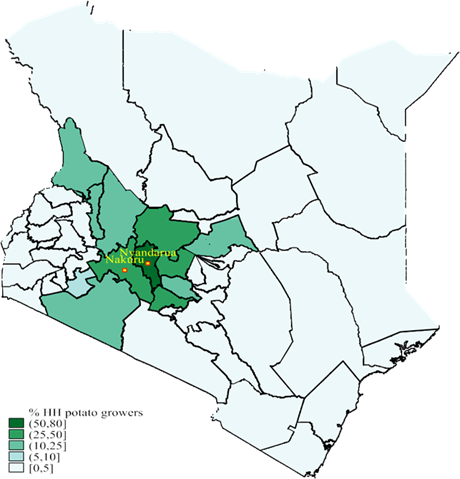
FIGURE 1: Map of potato-growing counties in Kenya, highlighting Nakuru and Nyandarua. Source: Figure 1 in the paper.
There are real problems here for a digital tool to solve. Kenya’s potato farmers wrestle with weather variability and climate shocks, patchy access to quality seed, limited storage, and wildly fluctuating prices. The dominant variety (Shangi) is praised for its growing speed and yield but matures for less than a month, so harvests arrive in bulk, prices then collapse, and farmers with nowhere to store the crop sell fast and cheap to whoever shows up. Better information on weather, markets, and how and when to store is exactly the sort of thing a well-built app could provide. The appetite, in principle, is there. The uptake is not.
The divide is not about hardware
Start with the somehow reassuring numbers. Almost three-quarters of households own a mobile phone, and about seven in ten own a smartphone. Seven in ten also say they use apps for farming. On the face of it, this looks like a digital success story.
However, the trouble is hidden in the word farming. Look at which apps households actually use, and the picture narrows sharply. Financial tools, M-PESA mostly, and communication tools, primarily WhatsApp and SMS, account for almost all activity. The genuine agricultural categories barely appear. Even weather, the most popular of them, reaches only about four households in a hundred. Input ordering, recordkeeping, extension advice, crop and livestock management: each scrapes along at one or two in a hundred. So when a farmer says she uses an app for farming, she usually means she gets paid through it and talks to her broker on it, not that she plans her season using its potential.
This depicts a different story. The classic image of the divide, a farmer without a phone, is largely outdated in these counties. The phones have arrived-to stay. What has not arrived is the leap from cash and conversation to agronomy.
The reasons are the most instructive part. Among farmers who do not use agricultural apps, the dominant barriers are not poor signal nor, at least in the first instance, costs of data bundles. They are awareness and literacy. Most simply, farmers do not know such tools exist, and many do feel unequipped to use them. Connectivity, the usual villain of these stories, trails well behind. The constraint, in other words, lies neither in the network nor in the handset. It is in the gap between what the technology can do and to what extent its users know how to use it.
The bridge runs through the service centres
If farmers are not -yet- digitally empowered in this story, who is? The answer points one step up the chain, to the intermediaries who serve them.
Farmer Service Centres (FSCs) are local agripreneurs who aggregate produce, supply inputs, and pass on advice, acting as the hinge between smallholders and the broader service market. Among them, app use is both wider and deeper. The large majority use apps for business and social interaction, reaching well beyond messaging into extension services, weather, and crop and livestock management. While 5 in 100 farmers use these agricultural apps, FSCs’ reliance sits between 20 and 30.
This matters because the entire logic of digital agriculture in this setting runs through these FSCs. The premise is straightforward: equip the intermediary first, and then the capability will flow downhill to the farmer. The baseline confirms the first half of that proposition. The FSCs are truly digitally capable, and those with more training experience offer farmers a noticeably richer bundle of services. What the baseline cannot yet show, because the trial has just begun, is the second half: whether that capability actually reaches the last mile to the farm. That is the question the study is built to answer, and it is worth clarify that, for now, it remains open till the trial is completed.
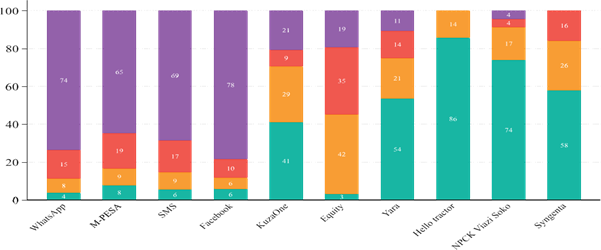

FIGURE 2: Frequency of app use among Farmer Service Centres. Source: Figure 6 in the paper.
Who risks being left on the wrong side?
The digital transition is not neutral about whom it carries and whom it strands, and two patterns in the data deserve attention before anyone can cheer.
The first is gender. Sort out who owns what, and a clear split emerges. Women are more likely than men to be the sole owner of a basic feature phone, while smartphones are more likely to be owned by men. Since the smartphone is the gateway to almost every advanced app, a transition built on smartphones risks quietly handing the future to those who can already access better hardware. In a sector where women do a great deal of the work, that is not a small caveat.
The second is youth. Young household heads are the most digitally engaged group in the survey: more than eight in ten use apps for farming, compared with seven in ten among old heads. Yet the same young households hold fewer assets, less land, limited livestock, less equipment. They are equipped with capability and not capital, which suggests that digital content might land quickly with them while a second type of support, asset-building, may be needed to turn that ability into a living.
Here the baseline offers a useful correction. The promise of digital agriculture often rests on a quiet assumption: that the hard part is getting a device into the farmer’s hand, and that the rest follows. Potato farmers in Nakuru and Nyandarua suggest something closer to the opposite. The device is the easy part; the hard part is the journey from a phone used for talking and paying to one used for accessing important information, growing, and that journey runs on awareness, confidence, and trusted intermediaries far more than on hardware.
That is precisely what the ongoing trial will test: whether training FSCs can bridge the gap, and whether women and young farmers are pulled across with them or left watching from the other side. The baseline has clearly drawn the starting line. The more interesting question is who ends up reaching the right side.
Sedi Anne Boukaka, Baragu Geoffrey, and Carlo Azzarri are, respectively, a research coordinator, a research officer, and a senior research fellow in the Agrifood Innovation and Resilience Unit of the International Food Policy Research Institute (IFPRI).
This post is based on research that has not yet been peer-reviewed. The work was carried out under the Strengthening Food Systems to Promote Increased Value Chain Employment Opportunities for Youth partnership with the Mastercard Foundation, with support from the CGIAR. The opinions expressed therein are those of the authors.
Reference: Boukaka, S. A., Geoffrey, B., & Azzarri, C. (2025). Digital tool integration, biodiversity, and the potato value chain in Kenya: Results from a baseline survey (SFS4Youth Working Paper No. 7). Washington, DC: International Food Policy Research Institute. Handle: https://hdl.handle.net/10568/177389