
By Fousseini Traoré, Pierre Mamboundou, Insa Diop, Abdourahmane Sy, and Audrey Lulu Mandi.
IFPRI Blog: Research Post
Key takeaways:
• Modelling the African Continental Free Trade Area’s realistic tariff-cutting scenario shows barely noticeable effects on GDP, wages, and poverty, mainly because most African trade already occurs under existing regional preferences, so continent-wide protection barely changes.
• Pair the same tariff cuts with a 25% reduction in transport costs, and the picture changes completely. Intra-African trade nearly doubles, GDP and wage gains multiply several times over, and poverty falls meaningfully in Rwanda.
• The gains are not evenly shared. Female-headed households benefit less than male-headed ones overall. However, cheaper transport helps close part of that gap by rewarding smallholders, many of them women, who sell into these newly opened markets.
This post is based on research that is not yet peer-reviewed.
In March 2018, heads of state gathered in Kigali to sign what was billed as the continent’s boldest economic project: a single market of 1.2 billion people and $2.5 trillion in combined GDP, with goods, services, businesspeople, and investment moving freely from Cairo to Cape Town. The African Continental Free Trade Area (AfCFTA) was meant to mark the moment Africa finally traded with itself.
Seven years on, a new IFPRI working paper subjects those promises to an economy-wide model of the whole continent, projected to 2035, and poses a blunter question: once the tariff schedules are implemented, how much difference do they make? The answer, for tariffs alone, is: not very much. But bolt on one additional, unglamorous ingredient, cheaper transport, and the same agreement starts to look like a genuinely different story.
Why cutting tariffs barely moves the needle.
The AfCFTA’s headline mechanism is simple: African countries reduce the duties they charge one another. The study models this in two ways. One scenario assumes full liberalization with no exceptions. The other, more realistic, allows each country to shield a small share (up to 7 percent of tariff lines held back as sensitive, plus another 3 percent excluded outright) of products in the actual negotiations.
In a realistic scenario, GDP gains for 2035 are effectively rounding errors: a hundredth of a percentage point here, a few hundredths there. Welfare gains, measured as the equivalent change in household income, look much the same. Even the reduction in intra-African tariffs, while genuine in places (double-digit percentage-point cuts in Central Africa’s customs union, for instance), does little to shift a country’s overall average tariff, because intra-African trade remains a modest share of most countries’ total trade with the world.
There is a structural reason for this muted effect. Most African countries already trade with their immediate neighbors under preferential terms negotiated through their regional economic communities, such as ECOWAS in the west and the East African Community. The AfCFTA mainly affects trade between these blocs, not within them. While the agreement genuinely creates new trade between African countries (as much as 18% more intra-African trade under full liberalization), it also diverts some trade away from efficient partners outside Africa towards less efficient ones within Africa and affects terms of trade. Central Africa’s customs union, CEMAC, is a case in point. Because it previously sourced 95% of its imports from outside the continent, the shift towards African suppliers leaves it worse off in aggregate welfare, at least in the tariff-only scenario.
None of this means the AfCFTA is pointless. It means tariffs were never going to do the heavy lifting.
Fix the roads, and the same agreement transforms.
Here is where the paper’s most striking result lies. Tariffs are not, in fact, Africa’s biggest trade barrier. Transport is. Unit transport costs on the continent run 40 to 100% higher than in other regions, a legacy of poor roads, landlocked geography, and creaking ports. Earlier research the authors draw on found that a 10% cut in transport costs raises trade by roughly 25%, and that shaving a single day off domestic travel time lifts exports by about 7%. Against numbers like that, a tariff schedule starts to look like a rounding exercise.
So the researchers ran a third scenario: keep the realistic tariff cuts, but also reduce transport margins by 25% within Africa and by 20% with the rest of the world, modelling the kind of infrastructure and logistics upgrade the continent badly needs anyway.
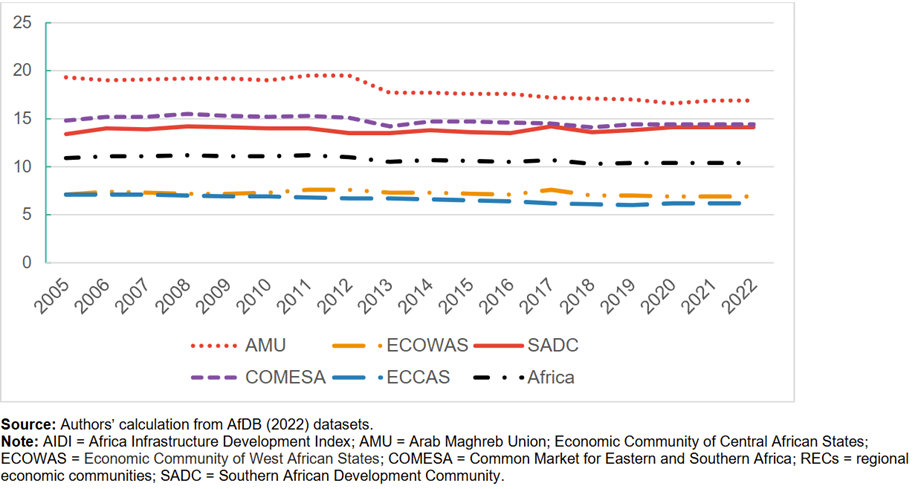
Figure 1: The AIDI infrastructure and transport index across Africa’s regional economic communities, 2005 to 2022, illustrating how far infrastructure quality still lags—source: Figure 5 or Figure 6 in the paper.
The results are not subtle. Intra-African trade, which grew by about 12% under the realistic tariff-only scenario, jumps to nearly 18% when transport costs also fall. GDP gains that were previously a rounding error become genuinely visible: Mozambique’s economy grows by more than half a percentage point above what it otherwise would by 2035, and Senegal’s by a similar margin, with welfare gains for both countries exceeding 1%, roughly ten times what tariff cuts delivered on their own. Wages for both skilled and unskilled workers, which barely moved under the tariff scenarios, rise meaningfully across nearly every country and region studied.
There is a pleasant surprise buried in the customs data, too. Governments often worry that trade liberalization starves the treasury, and indeed customs revenue falls in most countries under tariff cuts alone. But once cheaper transport boosts overall trade volumes, several countries, including Mozambique, Rwanda, and the Southern African Customs Union, see customs revenue rise rather than fall. A bigger, cheaper-to-trade-in economy can generate more revenue even at lower tax rates.
Who actually benefits?
The paper goes beyond continental aggregates. Using household survey data for Nigeria and Rwanda, it simulates how these scenarios ripple through poverty. The two countries tell different stories. Rwanda’s poverty headcount barely shifts under tariff cuts alone, but declines meaningfully once transport costs fall. Nigeria’s picture is murkier: overall poverty ticks up slightly in the transport scenario, but that average masks a sharper divide between net sellers of food, mostly farming households who gain from better market access, and net buyers, typically poorer urban and landless households, who see food prices rise and their poverty deepen slightly.
Gender adds another layer of nuance, not always a comfortable one. At the household level, female-headed households in both countries see smaller poverty reductions or larger increases than male-headed households under the transport facilitation scenario. Yet among smallholder farmers specifically, the pattern flips in Nigeria: poverty falls further for women-headed smallholder households than for men’s, largely because women more often lead the sale of agricultural produce and so capture the benefit directly when new markets open. In Rwanda, the reverse holds among smallholders, a reminder that “AfCFTA and women” is not a single story but several, shaped by who farms what and who sells it in each country.
The authors are candid about the limits of this. Because most African countries have not published an official list of the products it intends to protect or exclude from liberalization, the study had to infer these lists using a political economy model of lobbying, a reasonable proxy, but a proxy nonetheless. Furthermore, rules of origin, the technical criteria that determine whether a good genuinely qualifies as “African” for tariff purposes, are just finalized and could reshape who wins and loses once finalized. Finally, the true degree of openness of the continent is particularly underestimated because of informal cross border trade which is pervasive and barely included in official statistics and models.
Still, the direction of the finding is hard to argue with. The AfCFTA, taken purely as a tariff-cutting exercise, is a modest policy with modest effects. Fold in the transport and logistics investment that African leaders have talked about for decades, better roads, faster ports, shorter border queues, and the same agreement starts pulling its weight: more trade, higher wages, and, in at least one of the two countries studied in detail, real poverty reduction. The tariff schedules got the political attention and the summit in Kigali. The roads, it turns out, may be doing the actual work. The question now is whether the money and the political will follow the evidence, or whether the next seven years look much like the last.
This post is based on research that is not yet peer reviewed. The opinions expressed are those of the authors.
Reference: Traoré, F., Mamboundou, P., Diop, I., and Sy, A. 2025. The Impact of the African Continental Free Trade Agreement: A Continentwide Macroeconomic Assessment and Distributional Analysis in Nigeria and Rwanda. SFS4Youth Working Paper 5. Washington, DC: International Food Policy Research Institute.