


IFPRI Blog: Research Post
By Gashaw T. Abate, Serge Mugabo, Kalyani Raghunathan, Bjorn Van Campenhout and Audrey Lulu Mandi.
Key takeaways:
- A major institutional buyer’s requirement that its maize suppliers source at least 20% directly from smallholders raised average farmgate prices in the areas where it operated by 5 to 6%, mainly by attracting more aggregators to the market and increasing competition for grain.
- Aggregators linked to the buyer earned somewhat lower resale margins and, despite handling larger volumes, may have taken home lower overall profits; many stayed in the scheme regardless, likely for reasons beyond immediate margins.
- The gains were not limited to farmers selling into the scheme: farmers in the same areas who never transacted through it received price premiums of similar magnitude, consistent with competition working at the level of the local market.
- For participating farmers, the price premium more than covered the additional costs of meeting quality standards of the major buyer. The costs of the arrangement appear to be borne by intermediaries, whose margins narrowed market wide.
Economists have long argued that a committed buyer who creates a demand sink can be a powerful force for development. The export-led growth of East Asia was, at its core, a story of demand pull: manufacturers in Japan, South Korea, and Taiwan upgraded because large and demanding overseas buyers stood ready to absorb what they produced. Recent evidence suggests the same mechanism operates at much smaller scales. When Egyptian rug makers were randomly matched to a committed foreign buyer, their profits rose by 16% to 26%, and the quality of their rugs improved as the buyer’s feedback taught them new techniques. In Colombia, a multinational coffee buyer’s sourcing program, anchored by a purchase guarantee and an enforced farmgate premium, raised quality, exports, and farmer welfare, with the credibility of the buyer’s commitment doing much of the work.
Institutional buyers can, in principle, generate the same demand pull without the need to export. Governments and aid agencies purchase large volumes of food for school feeding programs and humanitarian operations, and there has been a deliberate shift toward procuring this food locally: buying grain in or near the countries where it will be distributed is substantially cheaper and faster than shipping it across oceans. Local procurement is often described as a rising tide: a large buyer commits to sourcing from smallholders, demand becomes more reliable, prices firm up, and farmers benefit. The evidence so far has been sobering, however. The most rigorous farmer-side tests to date, of the Purchase for Progress (P4P) pilot in Tanzania and of home-grown school feeding in Ghana, found no gains in farmer incomes, with unreliable payment the binding failure in both cases.
Uganda’s maize belt provides another test of the committed-buyer theory. The institutional buyer we study paid reliably, at scale, and season after season, and tied its purchases to a sourcing requirement that reached smallholders through potentially multiple layers of intermediaries. In a recent paper, we found strong evidence for the rising tide in this setting. We also found that the tide lifted more boats than the scheme’s traceability lists would suggest: the gains extended to farmers outside the scheme, while the costs fell on the traders in between, a result that offers useful lessons for how such programs are designed.
Reaching farmers through traders
In an effort to leverage existing supply chains to make procurement programs more inclusive and pro-poor, in 2021, a major institutional buyer began requiring its large trader-wholesaler suppliers to document that at least a fifth of the maize they delivered came directly from smallholder farmers, with a soft preference for women and youth sellers. The buyer contracts with wholesalers, who in turn rely on aggregators to buy grain at the farmgate, mostly from smallholder farmers. We call this indirect conditional contracting: a condition set at the top of the chain that passes through at least two layers of intermediaries before reaching smallholders. Some of these farmers know their maize is supplied to the buyer through aggregators.
We surveyed nearly 1,300 farmers and almost 300 traders and aggregators across six districts, comparing areas where this buyer was active with comparable districts where it was absent. Farmers in the buyer’s operating areas received farmgate prices roughly 5 to 6% higher than elsewhere. The buyer’s presence drew, on average, about two additional aggregators per area. Rather than simply passing along a fixed premium from the top, traders competed for supply, and farmers benefited through higher farm-gate prices.
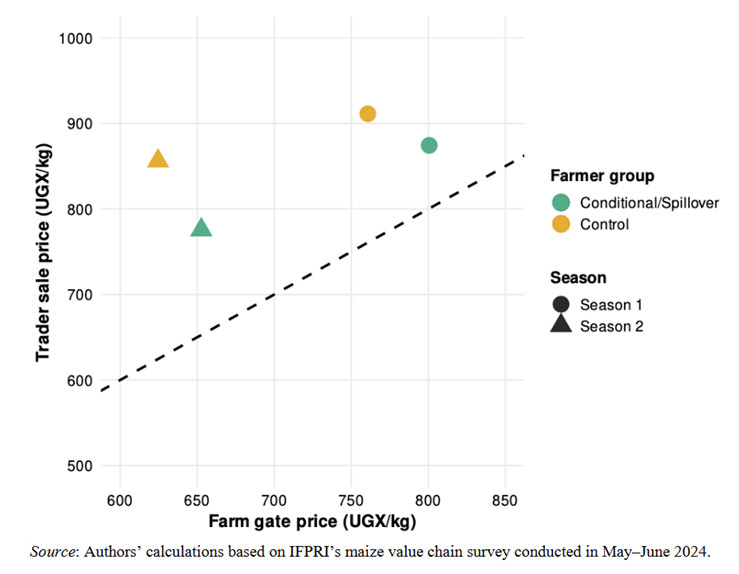
Figure 1: Farmgate prices and trader resale prices, by farmer group and season.
Aggregators in the buyer’s supply chain resold their maize at prices 6 to 7% lower than other aggregators, possibly because the buyer’s delivery schedules require them to sell early in the season, before prices typically rise. Their margins narrowed, and the paper’s back-of-the-envelope calculations suggest their overall profits may have been lower too, despite handling larger volumes. They kept participating anyway, likely for reasons beyond immediate margins, such as reliable access to demand, reputation effects, and hopes of future contracts. In effect, part of the margin that traders previously kept shifted towards farmers. Farmers connected to the conditional contract earned positive net returns per kilogram sold. By contrast, returns for farmers in the comparison areas were, on average, negative once inputs, postharvest costs, and labor were counted. Because family labor costs are imputed rather than directly paid, this comparison may understate how those farmers actually fare.
What about farmers outside the scheme?
The study also looked at general equilibrium effects. Farmers in the buyer’s operating areas who never sold to a connected aggregator received prices about 4 to 5% higher than comparable farmers in districts the buyer had not entered, a premium close to the area-wide average. This is consistent with the competition channel described above: as the buyer’s demand attracts additional aggregators, competition for grain intensifies across the whole local market, and registered and unregistered farmers benefit alike.
Economists have long suggested that conditional contracting could create a dual market, with one channel for connected, compliant farmers and another for everyone else. This concern is common in the broader literature on structured procurement and contract farming, but it has rarely been tested directly, and our paper is among the first to measure this risk using real transaction data. In our setting, the feared dual market does not materialize: the benefits of the buyer’s presence accrue to farmers inside and outside the scheme alike, and the distributional burden falls on the intermediary segment instead.
Who takes part, and what the findings do not show
The inclusion figures are encouraging. Roughly a third of the farmers selling into the buyer’s supply chain are women, and roughly a third are youth, shares broadly similar to those in areas where the buyer did not operate, with a modestly higher proportion of women sellers where the policy is active. Differences in who benefits do not appear to follow lines of gender or age. They relate more to whether a farmer sells to a connected trader.
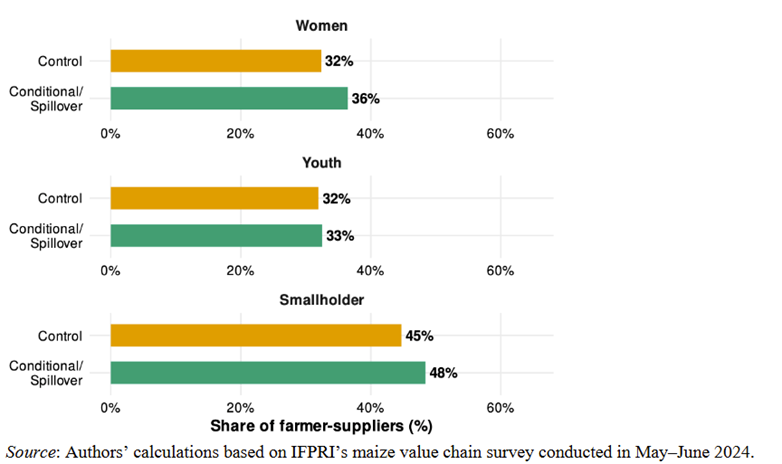
Figure 2: Share of women, youth, and smallholder sellers in treatment and control areas.
Overall, the study documents a real achievement. While avoiding the high cost of contracting directly with farmers, the buyer helped reshape a maize market: higher prices, wider adoption of improved seed and (for some inputs, such as urea) fertilizer, and more careful drying and grading of grain, all prompted by a sourcing requirement in a wholesaler’s tender. It shows that large buyers can influence markets through the traders they already work with, rather than building parallel channels that bypass them.
The paper also leaves policymakers with a design question. As structured demand from institutional buyers plays a larger role in how smallholders reach markets, the encouraging news is that the benefits need not stop at the scheme’s traceability lists: in our setting they reached farmers well outside it. The open question concerns the intermediaries who make the model work. If continued entry keeps compressing aggregator margins, the trading activity that transmits price incentives upstream may eventually cease to be privately profitable, and thoughtful program design will need to keep an eye on that margin.
Gashaw T. Abate is a Senior Research Fellow in the Markets, Trade, and Institutions (MTI) Unit of the International Food Policy Research Institute (IFPRI), Washington, DC. Serge Mugabo is a Senior Research Associate in IFPRI’s Development Strategies and Governance (DSG) Unit, Kigali, Rwanda. Kalyani Raghunathan was a Research Fellow in IFPRI’s Poverty, Gender, and Inclusion (PGI) Unit when this work was conducted, New Delhi, India. Bjorn Van Campenhout is a Senior Research Fellow in IFPRI’s MTI Unit, Leuven, Belgium.
This post is based on research that is not yet peer reviewed. The opinions expressed are those of the authors.
Reference: Abate, G. T., Mugabo, S., Raghunathan, K., and Van Campenhout, B. 2026. Can Local Procurement for Food Aid Foster Market Development? Evidence from Indirect Conditional Contracting in Uganda. IFPRI Discussion Paper 02423. Washington, DC: International Food Policy Research Institute.