
By Luciana Delgado, Josue Niyonsingiza, Fantu Bachewe and Audrey Lulu Mandi
Key takeaways:
- Nearly half of Rwanda’s bean harvest is lost along the value chain. Around 44% of the volume of output produced, and just under 29% of its value, disappear between the field and the final sale.
- The largest losses occur before harvest, not after it. About three-quarters of what farmers lose by volume happens in the field, to pests, disease, weeds, and erratic rain, which unsettles the common focus on storage and transport.
- Counting value instead of kilos flips the picture. Because beans gain value as they are dried, shelled, and carried to market, post-harvest losses cause the most economic damage, so the whole chain needs attention rather than just one end.
This post is based on research that is not yet peer-reviewed.
In Rwanda, the bean is not a side dish. It is the meal. Rwandans eat about 164 grams of beans per person per day, one of the highest rates anywhere, and almost every rural household grows them. Beans are protein, beans are income, and beans have long been regarded as a woman’s crop. So it should give us pause to learn that nearly half of all the beans grown never reach a plate or a paying customer.
A new baseline survey by IFPRI, carried out across all five provinces of Rwanda, sought to address a deceptively hard question: not simply to assert that food is lost, but to measure how much, and to pin down where along the journey it slips away. The headline figure is sobering. Of every harvest, roughly 44% of the volume is lost, along with just under 29% of its value. For a staple crop this central, that is a great deal of food, and a great deal of money, gone.
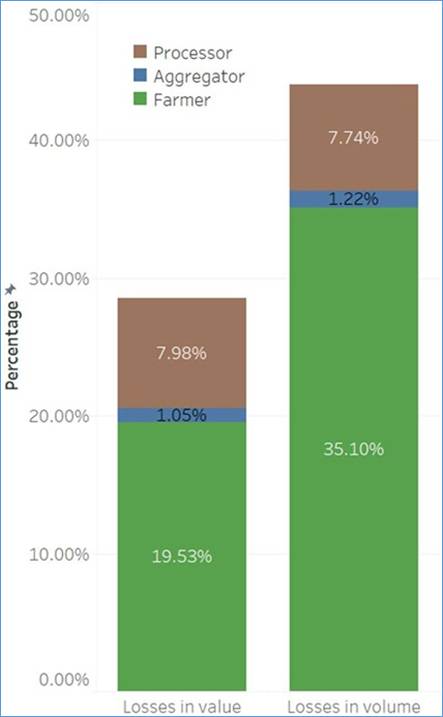
FIGURE 1: Estimated bean losses along the value chain, shown as a share of total volume and of total value, broken down by producers, aggregators, and processors. Source: Figure 7a in the paper.
The loss that hides in plain sight
Ask most people to picture food loss, and they will describe a sack of grain rotting in a damp store, or produce bruised on the back of a lorry. The intuition is so strong that entire programs are built around it.
The data tell a more uncomfortable story. When the researchers traced the sources of losses, the largest share occurred during the pre-harvest stage, which in this analysis includes losses occurring both before and during harvest. About three-quarters of what producers lose, measured by volume, vanishes in the field: eaten by pests, struck down by disease, crowded out by weeds, ruined by rain that arrived too hard or not at all, or lost due to delays in harvesting and/or use of poor harvesting techniques and tools.
Three out of four bean farmers reported experiencing pests or diseases during the growing season and responded by using bio-pesticides and hand weeding. Rather than causing measurable losses in the amount of harvest before it is produced, these challenges primarily affected the quality of beans before harvest. Damage from pests and diseases can reduce grain quality, making part of the harvest less suitable for sale or consumption, even when it remains harvestable.
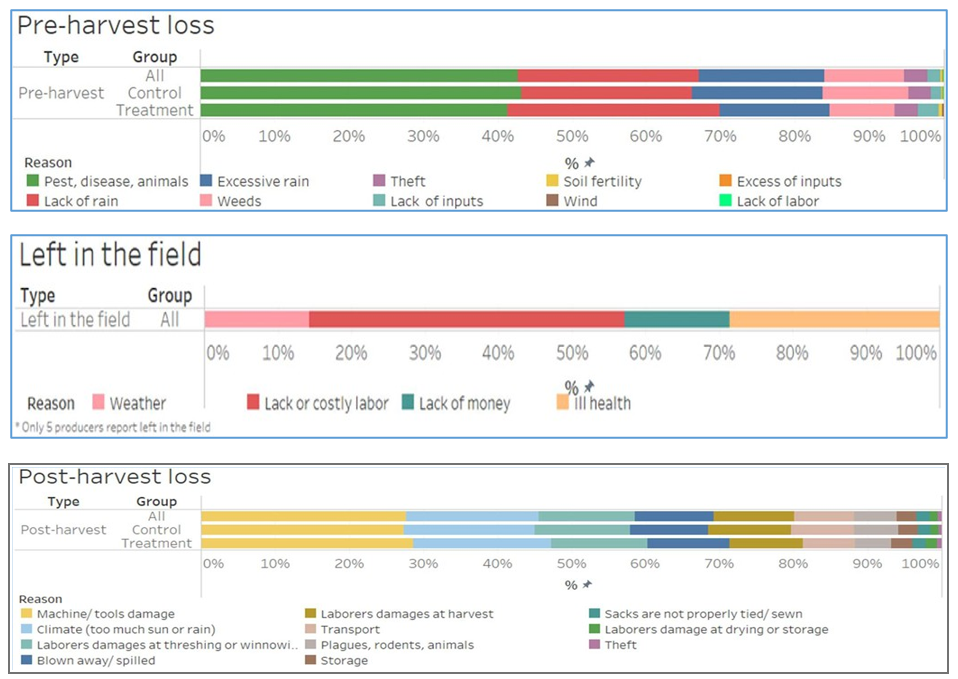
FIGURE 2: Self-reported causes of losses at the production stage. Source: Figure 8 in the paper.
This matters because it changes where you would look for solutions. If the biggest leak is in the field, then better seeds, timelier pest control, and protection against erratic weather are not secondary concerns to be tidied up once the storage problem is solved. They are equal to the storage problem.
Why kilos and francs tell different stories
And yet the field is not the whole story, because not every lost bean costs the same.
Here, the research draws a subtle and useful distinction. Measured in volume, pre-harvest losses dominate. Measured in value, the balance tips the other way: post-harvest losses account for nearly 60% of the value lost, while pre-harvest losses account for around two-fifths. The reason becomes clearer when considering how value is added along the value chain. A bean typically gains economic value as it moves from harvest through drying, shelling, transportation, and marketing, as additional labor, processing, and distribution costs are incorporated. As a result, losses occurring later in the value chain can have a greater economic impact relative to the volume lost. However, this relationship varies across contexts, and the difference between value and volume losses is more pronounced in some settings than others, such as Rwanda compared with Kenya and Nigeria.
So both ends of the chain demand attention, for different reasons. The field is where sheer quantity is lost. The stretch from threshing to sale is where the value bleeds out. Within that post-harvest stretch, almost everything is done by hand with simple tools, and almost everything leaks. More than nine in ten producers reported losses while threshing. Around half lost beans during drying. Nearly two-thirds lost some at shelling. These are not exotic failures. They are the ordinary friction of a value chain that has not yet been provided with better tools.
Who carries the loss?
One further pattern deserves to be drawn out, because it speaks to who bears the cost and who might help reduce it. Producers shoulder the overwhelming majority of losses, close to four-fifths of the volume, while the traders who aggregate beans account for almost none. The burden sits squarely on the farm.
The survey also looked closely at gender and age, and for good reason: this work is part of a wider effort, backed by the Mastercard Foundation, to create fulfilling and dignified livelihoods for young people, and especially young women, across Africa’s food systems. The findings are instructive. Young people make up only about 15% of the bean producers surveyed, and women, who have long carried this crop, tend to harvest less and to lose differently from men. Yet the youth who farm showed a quiet edge: they were quicker to adopt integrated pest management and biopesticides, while older farmers leaned on chemicals alone. It is a small detail with a large implication. If losses begin in the field and younger farmers are more open to methods that curb them, then engaging youth is not charity. It is a strategy.
What measuring well makes possible
It would be easy to read a survey like this as a catalogue of problems. It is better understood as a map. For years, the conversation about food loss in Rwanda and in much of the world has rested on a single arresting estimate: that about 40% of the country’s food supply is lost. That number is useful for raising an alarm. It is close to useless for action, because it cannot tell you where to intervene.
This is the real contribution of the work. By measuring losses crop by crop, stage by stage, and actor by actor, it turns a slogan into a set of addresses. It says, in effect: here is where to send better seeds, here is where training would pay off, here is where a sturdier tool or a tighter sack would save not just kilos but cash. You cannot fix what you have not first agreed to count.
The beans that vanish before harvest, and the ones that slip away after, are not an inevitability. They are a series of solvable problems hiding inside an average. The question Rwanda now faces, armed with a clearer picture than it had before, is which of those problems to solve first.
Luciana Delgado was a Senior Research Analyst in the Markets, Trade and Institutions Unit of the International Food Policy Research Institute (IFPRI). Josue Niyonsingiza is a Senior Research Analyst, and Fantu Bachewe is a Research Coordinator in IFPRI’s Development Strategies and Governance Unit.
This post is based on research that is not yet peer-reviewed. The opinions expressed are those of the authors.
Reference: Delgado, L., Niyonsingiza, J., & Bachewe, F. (2024). Quantifying food losses in the beans value chain in Rwanda: Analysis and results from a baseline survey (SFS4Youth Working Paper No. 2). Washington, DC: International Food Policy Research Institute. Available at: https://hdl.handle.net/10568/152031